Get in touch
Fill out the form and I’ll respond within 24 hours.
kosurusai646@gmail.com
Phone
+91 9515457049
Location
India
A timeline highlighting my education, projects, hackathon achievements, certifications, and technical growth.

Bachelor of Technology - Data Science
Manipal Academy of Higher Education, Udupi
Expected Graduation: July 2027
Specialization
Artificial Intelligence, Machine Learning, and Data Science
Technical Skills
Relevant Coursework

Cancer Gateway App / ERAS Protocol App
Developed an interactive Flutter mobile application in collaboration with MAHE and KMC Hospital, Udupi, to connect cancer patients with assigned doctors and support smoother pre-operative and post-operative care. The app organizes communication, treatment tracking, follow-ups, patient vitals, medication reminders, diet notes, lifestyle information, and image uploads into a single patient-care workflow.
Tools and Technologies: Flutter, Dart, Firebase Authentication, Firestore, Figma, Provider, Image Picker, and Local Notifications.
Achievement: delivered a functional interactive application to KMC Hospital and won a Rs.20,000 cash prize.
GitHub: Cancer Gateway App

Transformer Text Style Prediction
Built a character-level decoder-only Transformer for text-style learning. The model uses token embeddings, learned positional embeddings, masked multi-head self-attention, feed-forward blocks, residual connections, layer normalization, and next-token prediction. It trains on user-provided samples and generates text that attempts to mimic the learned writing style.
The project includes Python model code, backend training/generation flow, a simple HTML interface, screenshots, and a demo video link. It prioritizes conceptual clarity and local experimentation over large-scale optimization.
View GitHub RepositoryCourse by EDUCBA, completed April 5, 2025.
View Verification
FinLit.ai
Created a TypeScript financial-literacy app focused on dashboard workflows, AI-assistive finance features, user profiles, login/logout flows, menu navigation, upload screens, and mobile-style product exploration. The repo documents the app through screenshots for the AI feature, dashboard, home, login, profile, and upload screens.
Stack: TypeScript, Vite, frontend UI development, dashboard design, and AI-feature product exploration.
View FinLit.aiML-Filter
Started a lightweight HTML-based experiment for custom filters generated from user descriptions. The project explores the idea of turning a natural-language style request into a personalized visual/filter output.
View ML-FilterMental Health Therapy AI Agent Ecosystem
Built a backend-first AI support agent with FastAPI, Pydantic, LangGraph, LangChain, and Ollama. The API exposes an /ask endpoint that accepts a user message, invokes the agent, parses the tool call and final response, and returns a structured response to the frontend. The project uses local model workflows and has been developed around alibayram/medgemma:4b and Qwen2.5:7B.
Expanded the work into supporting repos: a Chroma vector database for mental-health PDFs/data, a frontend app surface, a landing page for project explanation and feedback, and agent UI experiments. The product direction includes retrieval-backed answers, local inference, frontend integration, emergency-contact workflow planning, model evaluation, future fine-tuning, and bounded safety behavior.
Deep Research Agent and All Agents UI
Created a FastAPI research-agent API around a graph-based pipeline. The /run-agent endpoint initializes a state object with search mode, collected URLs, parsed pages, filtered pages, verified pages, summaries, final summary, errors, and URL prompts, then returns a final summary through a clean API contract. The companion All_agents_frontend repo renders an AI assistant UI for interacting with these agent workflows.
View Deep Research AgentAI Map Colouring
Built an AI/CSP map-coloring system that turns region images into graph-coloring problems. The newer implementation uses OpenCV and NumPy to segment regions, dilate masks, infer adjacency, serialize adjacency to JSON, and solve the coloring with a backtracking algorithm using up to four colors. The related aiproject repo includes a MapColoringCSP solver with optional ML heuristics for choosing variables and color order.
View AI Map ColouringReliefOps AI - Smart Resource Allocation
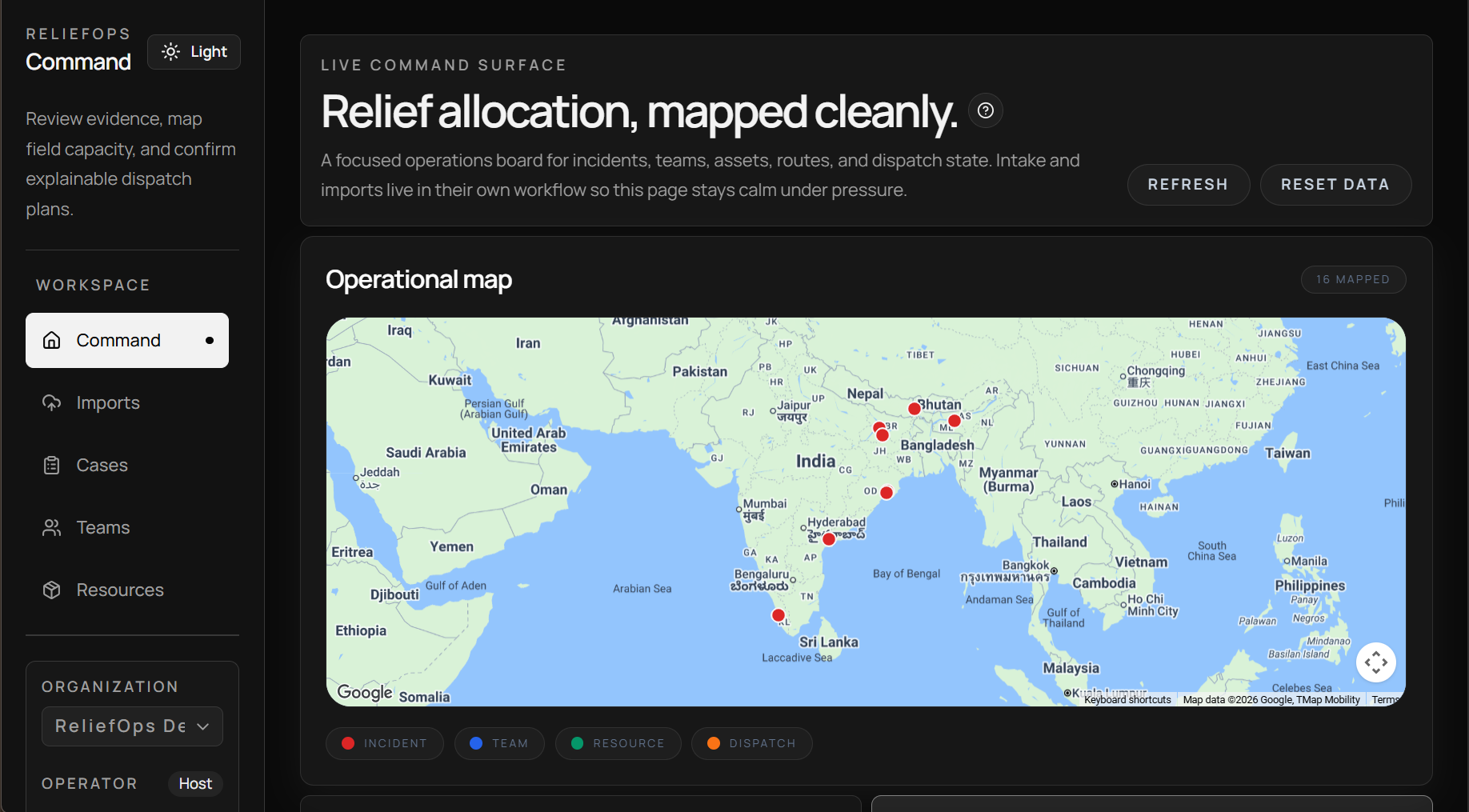
Built ReliefOps AI, a disaster-response coordination platform that converts messy NGO and field data into structured incidents, teams, volunteers, resources, and dispatch plans. The system combines AI-assisted intake with deterministic dispatch planning so operators can understand crisis inputs, review drafts, correct fields, and confirm operational records before anything is committed.
Graph 1 handles intake from CSVs, PDFs, images, notes, and mixed operational data. It extracts records, geocodes locations, flags duplicates, stores provenance, and presents editable drafts. Graph 2 handles single-case and batch dispatch planning, ranking cases globally, checking team/resource availability, enriching candidates with route ETA, and avoiding double-booking of scarce resources.
Stack: Next.js dashboard, FastAPI backend, Firebase Auth, Firestore, Gemini, Gemma/Ollama fallback, Google Maps JavaScript, Geocoding API, Routes API, Pydantic models, vector indexing, duplicate detection, and human-in-the-loop graph workflows.
View GDG / ReliefOps AI RepositoryProjecto Website + Billing Backend
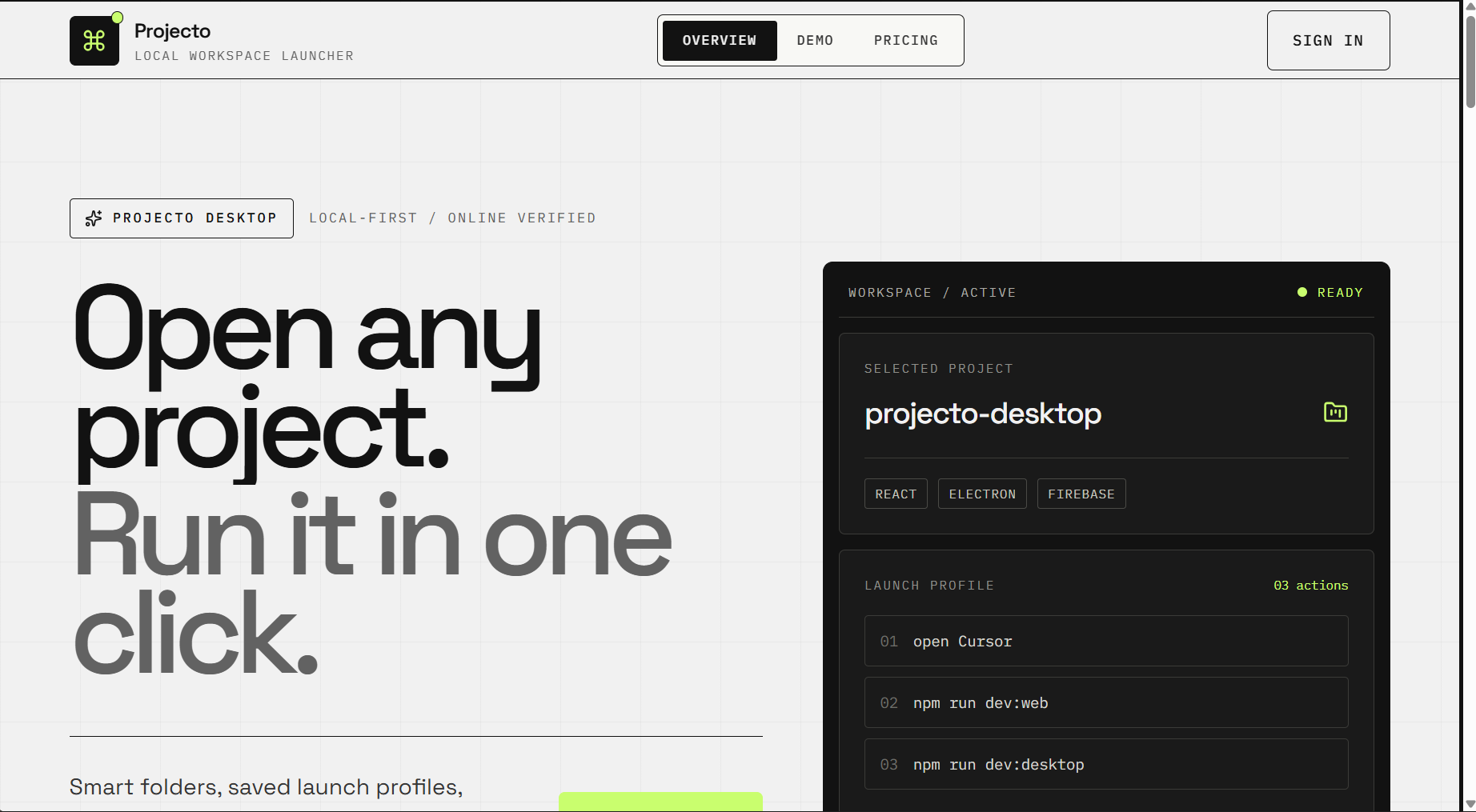
Built a Next.js 16 and TypeScript website/backend for a desktop product called Projecto. The web app manages user accounts, Google and Apple sign-in, Dodo Payments checkout, billing portal access, Firestore subscription records, desktop auth token exchange, and Electron subscription verification for Windows, macOS, and Linux.
The subscription backend handles Dodo webhooks, payment/subscription lifecycle events, effective Free/Pro plan checks, paid-through access rules, project archiving after downgrade, restoration after Pro renewal, and manual Pro overrides for support or testing. Desktop login uses short-lived callback codes and hashed rolling session tokens instead of exposing long-lived credentials in browser redirects.
View Projecto Website BackendInspireWorks Plivo IVR Demo
Created a Python and Flask IVR demo for Plivo. The app supports outbound call triggering, DTMF OTP authentication, wrong-OTP reprompting, language selection, second-level menu actions, audio playback, associate transfer, local demo flows, real-call mode, and Plivo XML responses for each voice step. A Vite frontend helps start demo calls and test the IVR routes.
View Plivo IVR DemoApp-Forge and Projecto Shell Repositories
Initialized additional public project shells for future product work. The substantive public implementation currently lives in projecto_frontend, while App-Forge and the base Projecto repo are early-stage placeholders for future expansion.
View App-ForgeProjecto is a Next.js 16 and TypeScript web app that acts as the source of truth for a desktop project-workspace product. It handles user accounts, Google and Apple sign-in through Firebase Authentication, Dodo Payments checkout, the customer billing portal, Firestore subscription records, desktop auth token exchange, and Electron subscription verification across Windows, macOS, and Linux. The backend is designed for real product entitlement logic. It processes Dodo subscription and payment webhooks, maps lifecycle events into Firestore, supports paid-through access after cancellation or failed renewal, reconciles Free/Pro project visibility, archives older projects when a user drops to the Free plan, and restores archived projects when Pro access returns. It also includes manual Pro overrides for support grants, internal testing, and temporary promotions. The desktop auth flow uses short-lived single-use callback codes and hashed session tokens, so long-lived desktop credentials are never placed in browser redirect URLs. The repo also documents deployment paths for Firebase App Hosting and Vercel, required environment variables, webhook setup, and verification commands such as lint, typecheck, tests, and build. Stack: Next.js App Router, TypeScript, Tailwind CSS 4, Firebase Authentication, Firebase Admin SDK, Firestore, Dodo Payments TypeScript SDK, Vitest, and Testing Library. Latest public update: pushed June 2, 2026. The full GitHub link is available from the card action, and the related shell repo is listed in the timeline.
View ProjectReliefOps AI is a maps-first emergency coordination system built for NGOs, disaster-response teams, hospitals, and municipal command centers. The project converts messy operational inputs such as WhatsApp-style messages, CSV sheets, PDF reports, field notes, images, maps, and spreadsheets into structured incidents, teams, volunteers, resources, and dispatch plans. The architecture separates AI understanding from operational truth. AI is used for extraction, reevaluation, warnings, and structured draft creation, while the backend owns resource stock arithmetic, team availability, route ETA, organization isolation, duplicate detection, final confirmation, and Firestore persistence. This keeps humans in control: operators review editable drafts, correct fields, reevaluate with prompts, and only commit records after confirmation. Graph 1 handles source-to-record intake. It parses uploaded files or text, extracts incidents/teams/resources, geocodes locations, flags duplicates, stores source provenance, and presents a reviewable GraphRun before persistence. Graph 2 handles dispatch planning. It can run single-case planning or global batch planning across all open cases, ranking emergencies, checking scarce assets, enriching candidates with Routes API ETAs, and avoiding double-booking of teams or resources. The system supports online and local/offline workflows. Online mode uses Firebase Auth, Firestore, Gemini, Google Geocoding, Google Routes, and Google Maps JavaScript. Local mode can fall back to memory storage, local Gemma through Ollama, heuristic extraction, approximate routes, and a local tactical map. Stack: Next.js operator dashboard, FastAPI backend, Firebase Auth, Firestore, Gemini, Gemma/Ollama fallback, Google Maps, Geocoding API, Routes API, Pydantic models, repository abstraction, vector indexing, duplicate detection, and human-in-the-loop graph workflows. Latest public update: created and pushed April 26, 2026. The GitHub repository is linked from the card action.
View ProjectA full-stack IVR demo for a Plivo technical assignment. The backend exposes voice routes for outbound call triggering, OTP authentication through DTMF input, wrong-OTP reprompting, language selection, second-level menu actions, audio playback, and associate transfer. It returns Plivo XML responses for each step in the voice flow. The project supports both local demo mode and real-call mode. In local demo mode, the frontend generates test links for OTP prompt, wrong OTP, correct OTP, language menu, audio playback, and dial-associate flows without placing a real phone call. In real-call mode, the app uses a public HTTPS webhook tunnel so Plivo can reach the Flask backend and place outbound calls to E.164 receiver numbers. Stack: Python, Flask, Plivo Python client, Plivo XML, DTMF menus, local tunneling, Vite frontend, and environment-driven demo/real-call switching. Latest public update: created and pushed May 16, 2026. The GitHub repository is linked from the card action.
View Project
A backend-first AI support agent for mental-health-adjacent conversations. The FastAPI server exposes an /ask endpoint that accepts a user message, invokes a LangGraph/LangChain agent, parses the tool call and final response, and returns both the generated answer and the tool selected by the agent. CORS is configured for local frontend development and a hosted frontend domain. The project uses local model workflows through Ollama and LangChain, with current model work centered around alibayram/medgemma:4b and Qwen2.5:7B. The broader system includes a Chroma vector database repository for mental-health PDFs/data, a Next.js frontend repo, and a separate landing page repo for explaining the concept, collecting feedback, and preparing for launch. The product direction is safety-aware: local inference, retrieval-backed mental-health resources, emergency-contact workflow planning, frontend integration, model evaluation, and future fine-tuning. The goal is not to replace professionals, but to build a supportive, bounded AI assistant that can guide users toward healthier next steps and escalate when needed. Stack: FastAPI, Pydantic, LangGraph, LangChain, Ollama, local LLMs, ChromaDB/RAG support, Next.js frontend work, and landing-page feedback collection. Latest public updates: backend pushed March 25, 2026; Chroma database and agent UI repos created March 2026. The main GitHub repository is linked from the card action, and related repos are linked in the timeline.
View Project
A public-facing Next.js landing page and companion frontend surface for the Mental Health Therapy AI Agent. The landing page explains the project, presents the intended features, gives visitors a way to understand the support model, and creates a path for user feedback, supporter interest, and future launch planning. The frontend repo extends the idea from concept into an application interface for interacting with the agent. Together, these repos show the product side of the AI agent system: not just the model/backend, but also the user-facing communication layer, onboarding direction, visual identity, and deployment workflow. Stack: Next.js, TypeScript, Tailwind CSS, reusable UI components, Vercel-oriented deployment, and frontend integration planning. Latest public update: landing page pushed February 12, 2026; app frontend pushed February 5, 2026. The landing page repository is linked from the card action, and the frontend repo is linked in the timeline.
View Landing RepoAI Map Colouring turns map/region inputs into a constraint-satisfaction graph coloring problem. The newer implementation uses OpenCV to process images, segment regions, dilate region masks, detect which labeled regions touch each other, and convert the resulting adjacency graph into JSON-safe data. A backtracking coloring solver then assigns up to four colors while ensuring neighboring regions never share the same color. The project includes backend logic for graph building, rendering, validation, and coloring, plus a frontend folder and Docker setup for running the system as an app. It connects classic AI/CSP theory to a visual task: taking a map-like input, inferring graph structure, solving the coloring constraints, and producing a valid colored output. Related earlier work in aiproject includes a MapColoringCSP solver with optional ML heuristics for variable selection and color ordering. That version loads graph data, applies backtracking, and can use a trained heuristic model to guide the CSP search. Stack: Python, OpenCV, NumPy, backtracking CSP, graph adjacency construction, Docker, Vite frontend, and optional ML heuristic work. Latest public update: AI_map_colouring pushed April 5, 2026. The main GitHub repository is linked from the card action, and the related CSP repo is linked in the timeline.
View ProjectDeep Research Agent is a FastAPI service wrapped around a graph-based research pipeline. The /run-agent endpoint accepts a query and invokes a graph app with state fields for search mode, collected URLs, parsed pages, filtered pages, verified pages, intermediate summaries, final summary, errors, and URL prompts. This makes the agent pipeline easier to inspect, extend, and connect to a frontend. All_agents_frontend is the companion Next.js interface that renders an AI assistant UI for interacting with agent workflows. The related common-agent repos form a shared base for multi-agent experimentation: a host API, agent-structure pipeline, reusable frontend shell, and room to plug in different specialist agents. The project is useful as a research/agent orchestration layer: collect sources, parse content, filter relevance, verify information, summarize findings, track failures, and return a final response through an API contract. Stack: Python, FastAPI, Pydantic, graph-based agent pipeline, CORS-enabled API service, Next.js, TypeScript, and reusable AI assistant UI components. Latest public update: agent and frontend repos pushed March 23, 2026. The main GitHub repository is linked from the card action, and the frontend repo is linked in the timeline.
View ProjectA character-level decoder-only Transformer language model inspired by Attention Is All You Need. The implementation uses token embeddings, learned positional embeddings, causal self-attention Transformer blocks, multi-head masked attention, feed-forward layers, residual connections, layer normalization, and a language-modeling head optimized with cross-entropy loss for next-token prediction. The project focuses on text-style learning: users provide sample text, the model trains on that style, and the interface generates new text that attempts to mimic the learned writing pattern. It intentionally keeps the architecture educational and local, using character-level sequences instead of subword tokenization and learned positional embeddings instead of sinusoidal encodings. The repo includes a simple web interface, backend training/generation logic, model code, context/input files, README screenshots, and a demo video link. Stack: Python, custom Transformer model, causal masking, autoregressive generation, Flask-style backend flow, and a simple HTML frontend. Latest public update: pushed April 13, 2025. The GitHub repository is linked from the card action.
View Project
A Flutter mobile app built with MAHE and KMC Hospital, Udupi, to support cancer patients before and after surgery. The app helps patients and assigned doctors communicate in a more organized way across pre-operative preparation, post-operative care, chemotherapy sessions, surgery dates, follow-ups, vitals, lifestyle inputs, diet tracking, medication reminders, and image uploads from affected areas. The app includes patient and doctor roles, Firebase Authentication, Firestore-backed data storage, treatment-plan management, emergency contact support, and calendar-style care tracking. Doctors can monitor patient progress while patients get a clearer care pathway across appointments and recovery steps. The project was delivered as a functional interactive application and won a Rs.20,000 cash prize. Stack: Flutter, Dart, Firebase Authentication, Firebase Firestore, Figma prototyping, provider state management, image_picker, and flutter_local_notifications. Latest public update: pushed February 11, 2025. The GitHub repository is linked from the card action.
View ProjectFinLit.ai is a TypeScript financial-literacy app focused on helping users understand and manage finance-related workflows through a modern mobile-style interface. The repo includes screens for home, dashboard, AI feature, login/logout, profile, menu, upload, and user-persona views, showing both product flow and interface exploration. The project demonstrates frontend product building around financial education: dashboard structure, AI-assistive feature direction, user profile flows, document/upload interaction, and a Vite-based development setup. Stack: TypeScript, Vite, frontend UI implementation, screenshot-driven app documentation, dashboard and AI feature screens. Latest public update: created and pushed September 10, 2025. The GitHub repository is linked from the card action.
View ProjectFill out the form and I’ll respond within 24 hours.
kosurusai646@gmail.com
Phone
+91 9515457049
Location
India